
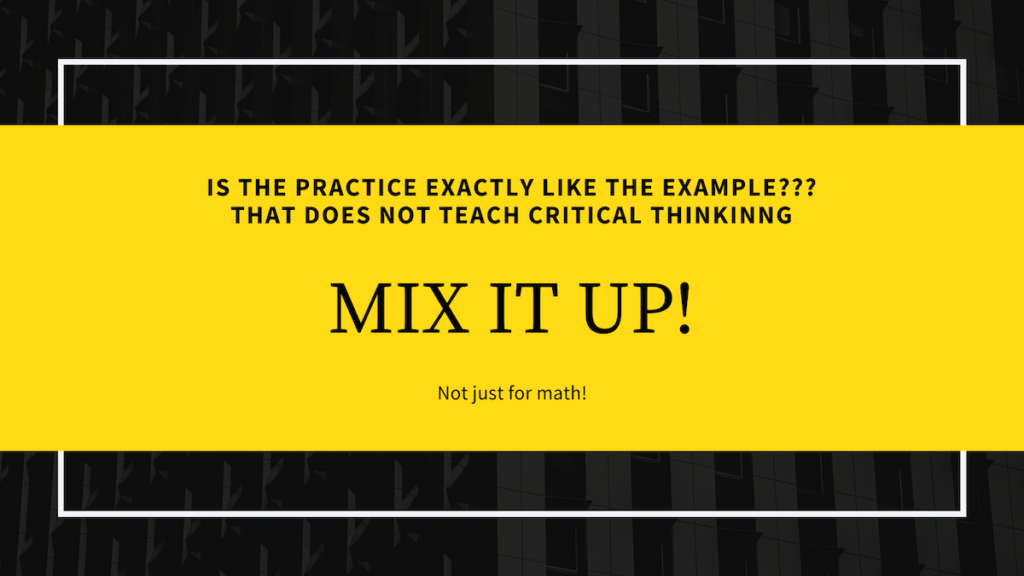
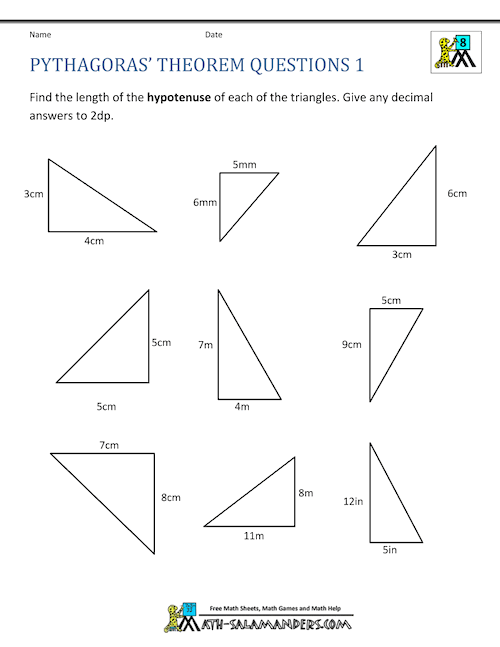
THIS IS NOT SPECIFIC TO MATH. Consider... do not give students a bunch of practice problems just like the example. I did a search for Pythagorean Theorem in Google Images and saw a bunch of worksheets come up where all of the practice problems are the same. Notice in this example that they ALL are finding the hypotenuse (also notice it does not label them at 90º angles so this is extra terrible.)
Google It
The first problem with this worksheet is it was designed for a century that doesn't exist anymore. There are websites that will easily spit out the answer to this. WITH THE STEPS. It is naive to think students are not doing this. Even without Google they copied off each others paper.
Quizizz or Digital Tools
HOW DOES THIS IMPROVE LEARNING should be our first question when using technology.
I love to use http://quizizz.com for low critical thinking problems, not just because it's harder to copy off a kids paper. Quizizz mixes up the questions and the answer choices. BUT MORE IMPORTANTLY you can have them practice until they are successful.
Redo is good for learning. Low scores are not.
Regardless, if it is Quizizz or some other digital tool... giving practice problems exactly like the example reduces the cognitive load. You do not have to think if you are EXPECTING a question just like it. I know we think it makes sense to give them repetitive practice so they get it down solid, but they are not thinking about what they are doing and thus... more likely to forget it later.
What do you think would happen if...
Here is an example... now here is one that may or may not fit the pattern. Does it? Why do you think this is similar to the example or not similar?
Interleaving
Does your lesson plan book look something like Monday standard 1.1 and Tuesday standard 1.2 and Wednesday standard 1.3? Where you learn one thing and then do a bunch of isolated practice around that one thing? Research shows it is better to INTERLEAVE! This means you mix up topics. You want students to have to think about what they are doing rather than expect that they know what the next problem is going to be.